
Secrets manager comparison
Automic Vault vs AWS Secrets Manager
AWS protects secret resources in the cloud. Automic Vault protects the local credentials used to reach AWS and controls which verified Mac app may exercise them.
Published August 14, 2026 · Source checked against current product documentation
Choose AWS Secrets Manager for cloud storage, resource-level IAM policy, automatic rotation, versioning, multi-account access, and CloudTrail events. Choose Automic Vault to protect AWS and other developer credentials on a Mac and to give Terminal, agents, and editors different command policy. AWS Secrets Manager secures the secret service. Automic Vault secures local developer authority before an AWS request exists.
IAM Decides Who May Retrieve a Secret
actions and resourcesAn identity-based IAM policy can grant secretsmanager:GetSecretValue for one exact secret ARN, a name prefix, or resources selected through tags and conditions. Applications on EC2, Lambda, ECS, or other AWS services can use roles rather than stored access keys.
This is fine-grained cloud authorization. The identity may read only the named database password and nothing else. KMS permissions add another control when a customer-managed key encrypts the secret.
The API returns the decrypted value in SecretString or SecretBinary. The AWS CLI prints it in its response:
aws secretsmanager get-secret-value --secret-id payments/databaseAny local process that can use the same AWS identity can make that call. IAM sees the principal, action, resource, request attributes, and AWS context. It does not see whether Terminal, Codex, or a compromised editor extension launched aws.
The Local AWS Identity Is the Bootstrap Secret
how the Mac gets inA workload role is the preferred answer inside AWS. A developer laptop may use IAM Identity Center, federation, a credential process, or access keys. Whatever method succeeds becomes ambient authority for every process that can reach its cache, config, environment, or helper.
AWS Secrets Manager cannot store the credential needed to authenticate the same unauthenticated CLI call. The Mac needs an independent route into AWS. If that route is a plaintext profile or exported session, local agents inherit it.
Automic Vault's AWS Hardener imports the supported default access key pair into Keychain and removes the ambient credential chain from the protected AWS process. It installs a protected launcher that still answers to aws. The menu app exchanges long-lived keys for temporary STS credentials, supports MFA and role profiles, and binds issuance to one registered AWS process.
Automic Vault Classifies the AWS Command
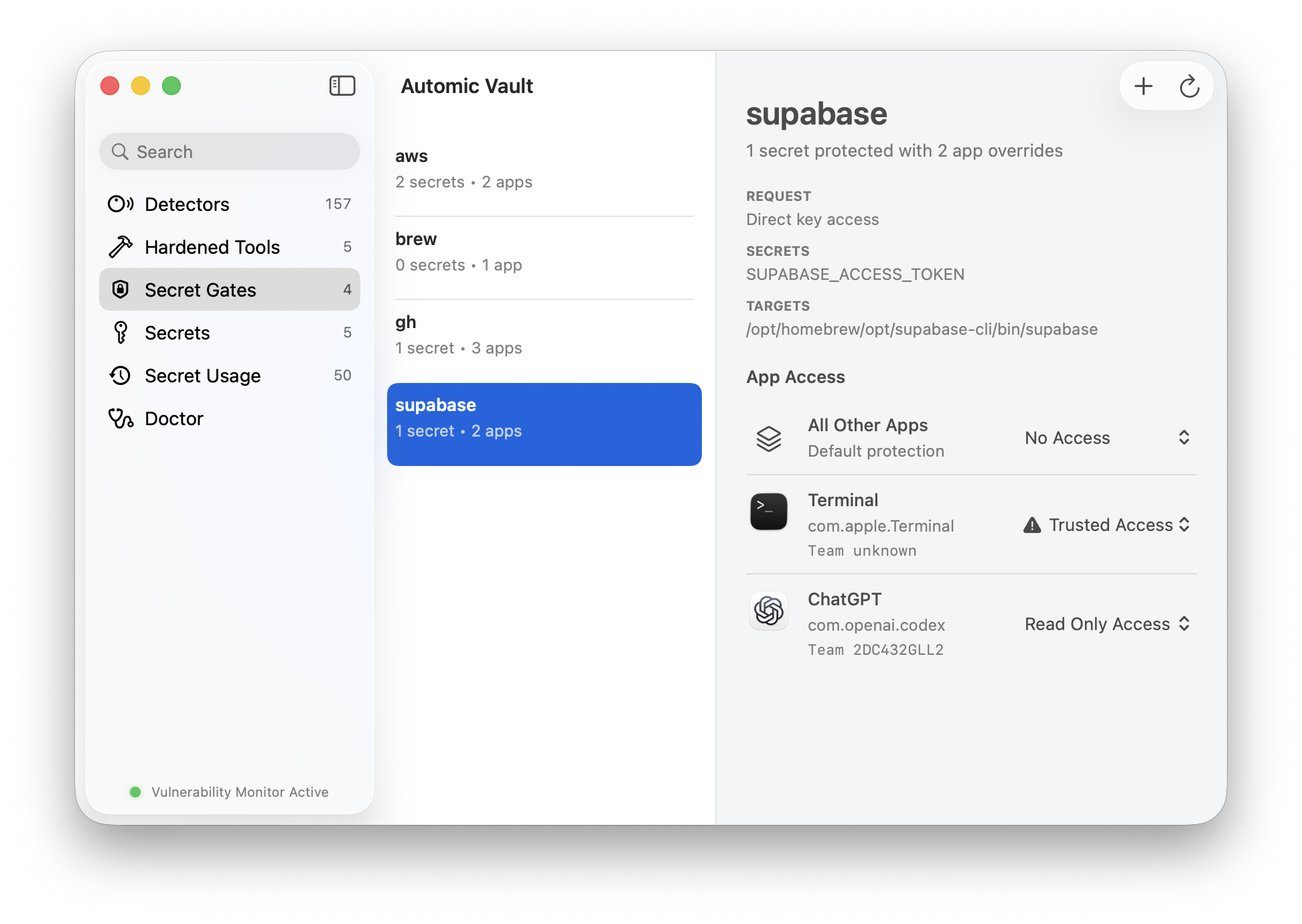
local intentThe AWS gate follows the live process chain to a Verified Launcher and binds the request to the AWS Target, arguments, selected profile, process identity, and configuration snapshot. Terminal, Codex, and an editor can receive different Access Levels.
The shipped AWS command policy recognizes a reviewed set of read-only calls. It permits metadata operations such as secretsmanager describe-secret and list-secrets at Read Only. It deliberately excludes get-secret-value from that set, so an agent with Read Only cannot retrieve the raw secret. The command needs a higher Access Level or Approval.
Automic Vault does not duplicate IAM. IAM still decides whether the AWS principal may call GetSecretValue. Automic Vault decides whether this local Launcher may cause the protected AWS credentials to be applied to that command. Both decisions must allow the operation.
AWS Owns Rotation and Versions
managed secret lifecycleAWS Secrets Manager stores versions with staging labels such as AWSCURRENT and AWSPREVIOUS. Managed rotation updates supported managed secrets. Lambda rotation can update other databases and services. AWS can replicate secrets across Regions and integrate them into deployed workloads.
Automic Vault stores opaque developer Secrets in a local Keychain. It does not rotate a database password in both the database and AWS, coordinate replicas, or supply a cloud application fleet. Its availability setting controls whether a local Secret may be returned while the Mac is locked; it does not manage remote versions.
Use AWS Secrets Manager for application and infrastructure secrets already inside AWS. Use Automic Vault for the developer authority that reaches cloud control planes and other local Tools.
CloudTrail and Authorization History See Different Events
two audit planesCloudTrail records Secrets Manager API calls, including GetSecretValue, without logging the sensitive response field. A trail can retain events in S3 across accounts and Regions. This is the durable cloud record teams should use for AWS investigations.
Automic Vault writes a local Authorization Record before allowed Secret Use. It records the Verified Launcher, Gate Client, Target, Secret Names, operation, decision, and decision source. This answers which Mac app caused the protected credential to be applied.
Authorization History is bounded local operational history, not an append-only forensic log. CloudTrail is stronger for centralized AWS audit. Automic Vault adds endpoint attribution that AWS cannot observe.
AWS Is One Tool Among Many
developer tool hardeningAutomic Vault scans supported configurations across more than one hundred developer Tools. A Finding may identify a plaintext credential, inherited environment variable, permissive Keychain item, helper command, or unsafe configuration. Hardening migrates or mediates supported Tools, and Doctor verifies each intervention.
AWS Secrets Manager cannot repair a GitHub token in a credential helper, a package-manager token in a dotfile, or Homebrew execution policy. It is a cloud secret service. Automic Vault operates across the local developer toolchain and also gates controlled operations that use no secret, such as Homebrew installation.
Automic Vault is narrower in deployment scope and broader in local Tool scope. It remains macOS-only and does not replace cloud IAM or Secrets Manager.
Which One Fits?
usually bothCloud application secrets
Use IAM resources, rotation, versions, replication, SDK retrieval, and CloudTrail for AWS workloads.
Mac developer authority
Protect local AWS credentials and classify the command requested by each Verified Launcher.
Two independent decisions
Require Automic Vault's local policy and AWS IAM policy before a developer process can retrieve a cloud secret.