
TanStack npm compromise
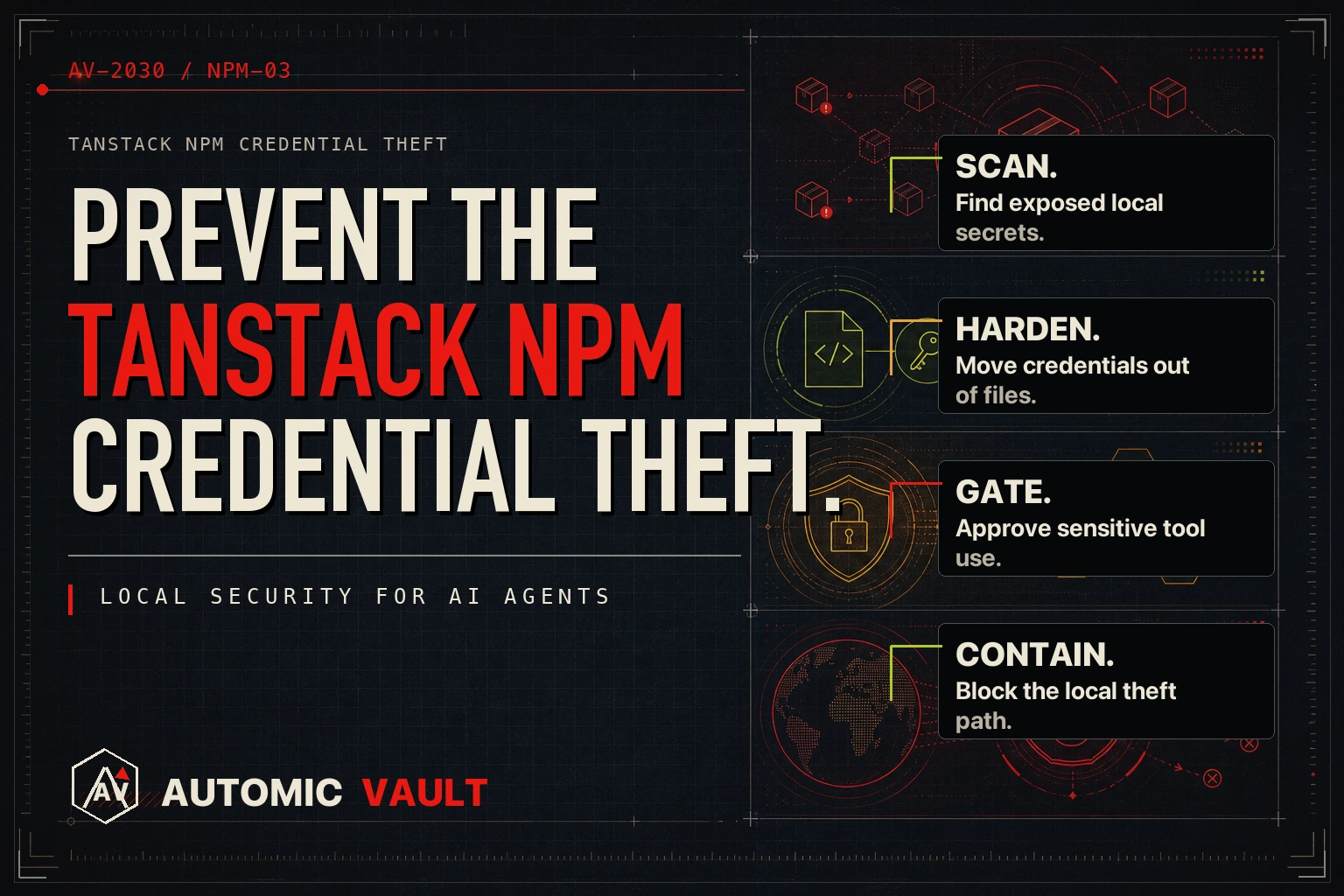
How Automic Vault would have prevented the TanStack npm credential theft.
The TanStack attack bypassed normal package trust by abusing the release pipeline. Automic Vault would not need to predict that upstream chain. It would have prevented the installed malware from reading local secrets and turning a valid npm package into an endpoint breach.
Published May 15, 2026
Automic Vault would have prevented the damaging local phase of this incident: the moment malicious package or extension code tried to read workstation secrets, use credential-bearing tools, or install persistence as the developer.
Incident Facts
local execution- Date
- May 11, 2026
- Trigger
- 84 malicious versions across 42 @tanstack packages were published through the trusted npm path.
- Local targets
- Cloud credentials, kubeconfig, SSH keys, GitHub and npm state, Docker config, Terraform files, Claude and Kiro MCP configs, and editor hooks.
- Follow-on behavior
- Session/Oxen file uploads, additional command-and-control domains, GitHub API abuse, and local persistence in AI/editor configuration.
What Happened?
incident recordTanStack published a detailed postmortem showing that the attacker chained a pull_request_target workflow pattern, GitHub Actions cache poisoning, and OIDC token extraction from runner memory. The result was not a fake package. It was a poisoned package published through a trusted path.
That upstream story is important, but the local story is what hurts developers. Once the malicious packages resolved on a workstation, the payload searched for the usual developer secrets: cloud CLI state, SSH keys, npm and GitHub credentials, Kubernetes config, Docker config, Terraform credentials, and AI-tool settings.
The malware also targeted persistence surfaces that are specific to modern developer workflows. It wrote into Claude settings, VS Code tasks, and monitor-style local files. That is a clear signal that attackers now treat AI and editor configuration as credential-bearing infrastructure.
Failure Point
root causeTanStack had modern supply-chain controls, but the package that reached developers could still contain malicious runtime behavior. Provenance can tell you where a package came from. It cannot guarantee that code running locally should read ~/.aws, ~/.ssh, or .claude configuration.
The practical lesson is that release integrity and local least privilege are different controls. You need both. When release integrity fails, local least privilege decides whether the compromised package becomes a machine-wide credential breach.
Where Automic Vault Would Have Stopped It
preventionLocal secret exposure would be removed
Automic Vault scans for local secret hazards and moves supported secrets out of files that package code can read directly. The payload would not find the same plain credential map.
Agent and editor config would be treated as sensitive
Claude, MCP, and editor task files are part of the local authority surface. Automic Vault shows package, path, Credential, Launcher, and Target context before a Tool gets sensitive access.
Dangerous tool use would hit gates
GitHub writes, package publishing, cloud mutations, and secret injection are approval boundaries. A poisoned dependency does not get to use those capabilities invisibly just because it arrived through npm.
Workstation Prevention Boundary
local boundaryAutomic Vault would have prevented the damaging endpoint phase by making the malicious package run without the broad credential set it expected. The upstream npm publish would still be a serious incident, but the workstation would not be an all-you-can-read secret sink.
Local developer credential protection still matters when a project has SLSA, OIDC trusted publishing, and transparent postmortems. The package still executes on a developer machine.
For TanStack, the strongest prevention claim is simple: Automic Vault would have broken the attacker assumptions that home directories are readable, secret-bearing CLIs are ambient, and editor or AI-tool hooks can be modified without a visible security decision.
Automic Vault does not claim to make npm, PyPI, GitHub Actions, or extension marketplaces impossible to compromise. The prevention claim is narrower and more useful: compromised tools should not inherit every credential and sensitive path on a developer machine.