
GitHub employee device breach
How Automic Vault would have prevented the GitHub employee device breach.
The GitHub aftermath is the cleanest proof that local developer compromise can become organization-wide source exposure. Automic Vault would have prevented the poisoned extension from turning one endpoint into a bridge to internal repositories.
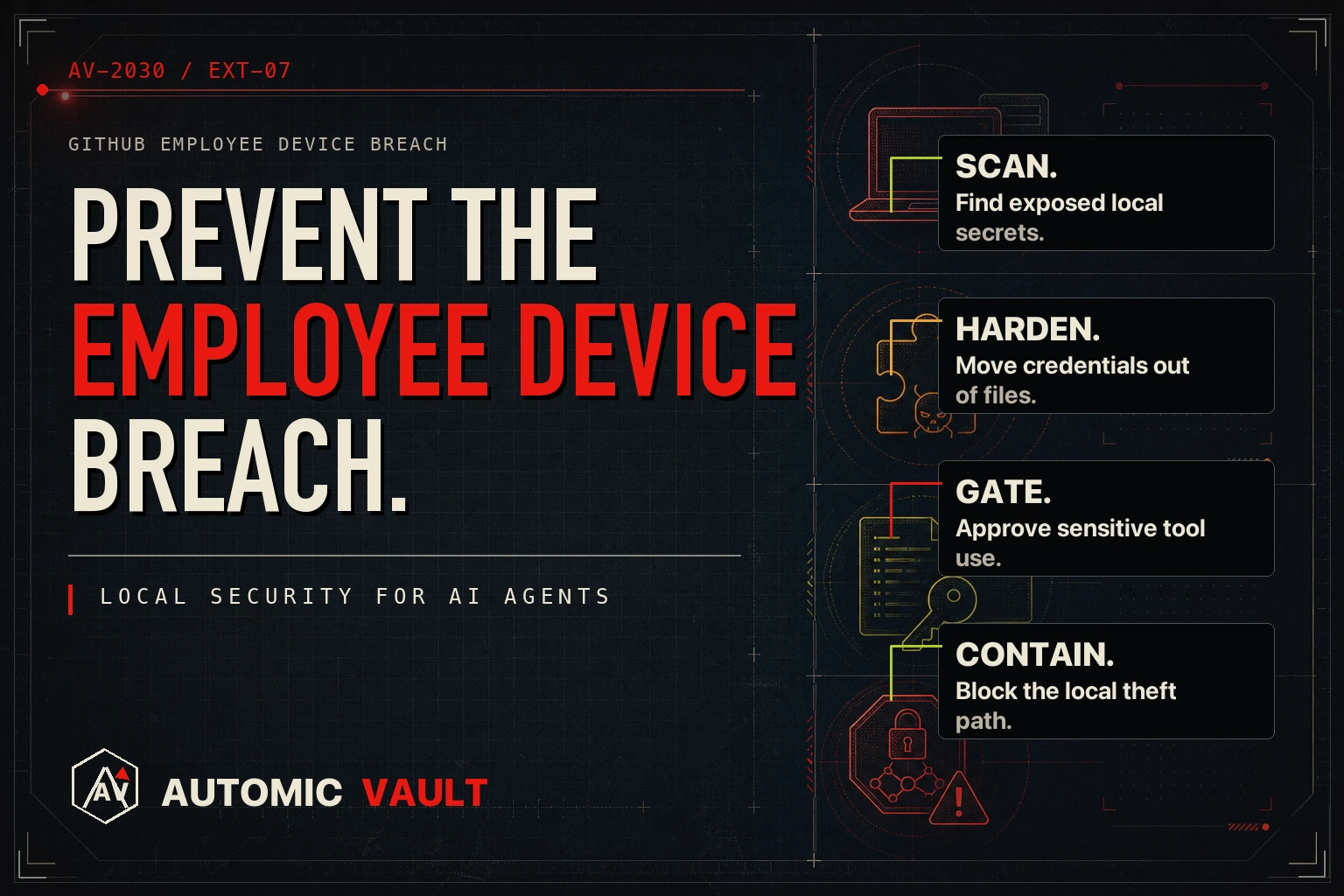
Published May 21, 2026
Automic Vault would have prevented the damaging local phase of this incident: the moment malicious package or extension code tried to read workstation secrets, use credential-bearing tools, or install persistence as the developer.
Incident Facts
local execution- Date
- May 18 to May 20, 2026
- Trigger
- A poisoned VS Code extension compromised an employee device; public reporting later linked the chain to Nx Console.
- Local targets
- Editor session authority, repository access, GitHub auth material, local secrets, and source-control context available from the employee workstation.
- Follow-on behavior
- Exfiltration of GitHub-internal repositories, immediate endpoint isolation, secret rotation, and incident response.
What Happened?
incident recordGitHub publicly confirmed in May 2026 that an employee device was compromised through a poisoned VS Code extension and that the activity involved exfiltration of GitHub-internal repositories. Public reports said the attacker claim of roughly 3,800 repositories was directionally consistent with GitHub investigation statements.
The chain matters: a developer tool update ran on a workstation, reached local auth and repository context, and became a source-code exposure event for a major developer platform.
That is the downstream version of the same pattern visible in LiteLLM, Bitwarden CLI, TanStack, node-ipc, Nx Console, and durabletask. The package or extension compromise happens upstream. The breach happens when the local machine grants broad authority to the compromised code.
Failure Point
root causeGitHub is one of the most security-aware developer organizations in the world, which makes the lesson harder to dismiss. A single endpoint with a poisoned developer extension can still become a repository access path if local credentials and source-control authority are available to that process.
The usual answer is faster detection and faster rotation. Those are necessary, but they are still response controls. The prevention control is to make the endpoint incapable of handing raw repository credentials and local secrets to arbitrary extension code in the first place.
Where Automic Vault Would Have Stopped It
preventionRepository access would not be ambient
Automic Vault treats source-control credentials and command execution as local authority that should be scoped to trusted tools and approved operations, not exposed to every process in an editor session.
Secrets would stay behind a local broker
The poisoned extension would lose the plaintext local tokens, SSH material, cloud credentials, and tool configs that turn one machine into many downstream accounts.
High-impact actions would be visible
Repository exfiltration, credential use, package publishing, and cloud or source-control mutations are exactly the kind of actions that should produce a local approval or hazard signal before they run.
Workstation Prevention Boundary
local boundaryAutomic Vault would have prevented the GitHub employee device breach at the workstation boundary. It would not have made the upstream extension ecosystem perfect. It would have denied the compromised extension the local materials needed to become repository access.
That prevention claim is stronger than advice to be careful with extensions. Developers need extensions and packages. The missing control is a local execution layer that assumes one of those tools will eventually be bad and still refuses to hand it the whole workstation.
The GitHub incident is the reason Automic Vault exists: secure the tools developers install before a trusted package, CLI, or editor extension gets one bad update.
Automic Vault does not claim to make npm, PyPI, GitHub Actions, or extension marketplaces impossible to compromise. The prevention claim is narrower and more useful: compromised tools should not inherit every credential and sensitive path on a developer machine.