
durabletask PyPI compromise
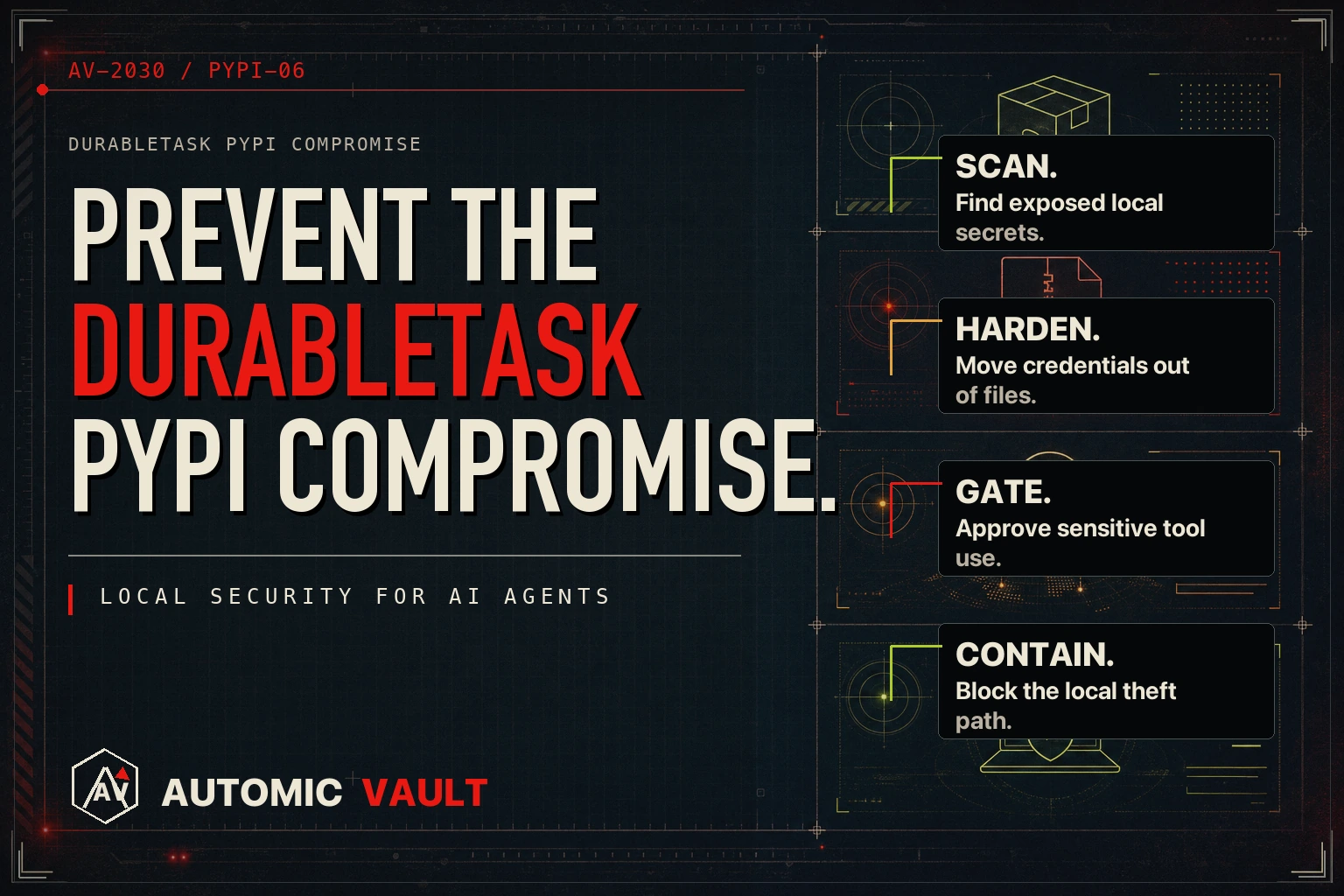
How Automic Vault would have prevented the durabletask PyPI compromise.
The durabletask incident turned a Python import into a cloud and developer credential collection path. Automic Vault would have prevented the package from converting local workstation authority into stolen cloud, SSH, and infrastructure secrets.
Published May 20, 2026
Automic Vault would have prevented the damaging local phase of this incident: the moment malicious package or extension code tried to read workstation secrets, use credential-bearing tools, or install persistence as the developer.
Incident Facts
local execution- Date
- May 19, 2026
- Trigger
- durabletask 1.4.1, 1.4.2, and 1.4.3 contained import-time dropper code.
- Local targets
- AWS, Azure, GCP, Kubernetes, SSH, Docker, npm, PyPI, Cargo, Terraform, Pulumi, Ansible, Vault, 1Password, Bitwarden, pass, and gopass material.
- Follow-on behavior
- Download and execution of rope.pyz, encrypted exfiltration, fallback channels, persistence, and possible cloud or Kubernetes lateral movement.
What Happened?
incident recordOn May 19, 2026, three malicious durabletask releases appeared on PyPI. StepSecurity reported that the versions were uploaded directly to PyPI without corresponding GitHub tags, releases, or CI/CD runs, which points to a publishing credential compromise rather than a normal repository release.
The package contained a small Python dropper that fetched a second-stage payload named rope.pyz from attacker infrastructure. The malicious behavior began at import time, so a developer, CI runner, or service importing durabletask could trigger the collection chain.
The second stage targeted a broad infrastructure surface: cloud credentials, Kubernetes contexts, SSH keys, Docker config, package registry tokens, Terraform and Pulumi state, Ansible vault passwords, HashiCorp Vault, and local password-manager tooling.
Failure Point
root causeThe failed assumption was that a legitimate PyPI project imported by a trusted application should inherit the host account. Once durabletask code executed, it had enough local authority to enumerate cloud and infrastructure secrets far outside the narrow job of a workflow SDK.
This is exactly where detection-only security is too late. If the import runs and rope.pyz reads the local credential map, the response becomes rotation, investigation, and rebuild. Prevention requires making those credentials unavailable to arbitrary library code in the first place.
Where Automic Vault Would Have Stopped It
preventionImports would not expose raw infrastructure secrets
Automic Vault keeps supported credentials out of plaintext developer files and makes local secret hazards visible. A library import would not receive the workstation as an open credential filesystem.
Secret-manager and cloud use would be scoped
Cloud and secret-manager access should happen through approved tools with visible target context. A downloaded Python zipapp does not get broad AWS, Kubernetes, Vault, or password-manager authority by default.
Dropper and persistence behavior would be constrained
Fetching a second-stage payload, installing service files, and running follow-on infrastructure commands are meaningful execution boundaries. Automic Vault puts those tool actions under local control.
Workstation Prevention Boundary
local boundaryAutomic Vault would have prevented the durabletask compromise from becoming a full environment compromise by removing the package import from the credential trust path.
The poisoned wheel could still exist. The import could still be attempted. But the attack would not find broad local secrets, would not receive approved credential injection, and would not silently cross into cloud, Kubernetes, or password-manager operations.
That is the difference between a compromised dependency and a compromised developer environment.
Automic Vault does not claim to make npm, PyPI, GitHub Actions, or extension marketplaces impossible to compromise. The prevention claim is narrower and more useful: compromised tools should not inherit every credential and sensitive path on a developer machine.